Live · updated daily
Forecast accuracy
How the models we ingest score against NOAA analysis.
We don't train a forecast model of our own. We ingest the National Blend of Models, HRRR, RRFS, and GFS, and serve a priority blend with NBM first. Each of those source models is scored on its own against NOAA analysis: URMA for the surface, MRMS Multi-Sensor QPE for rain.
What skill means here
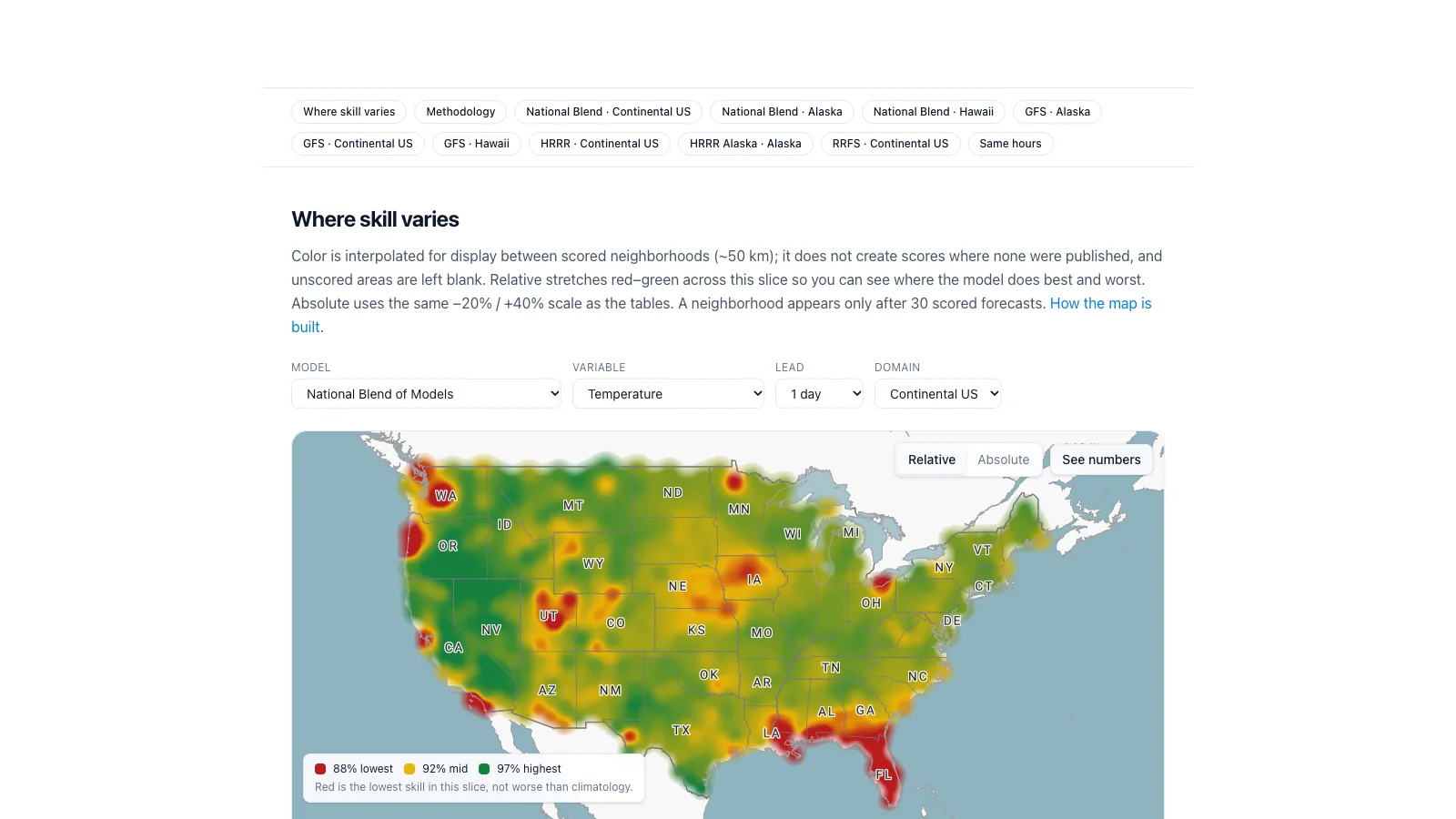
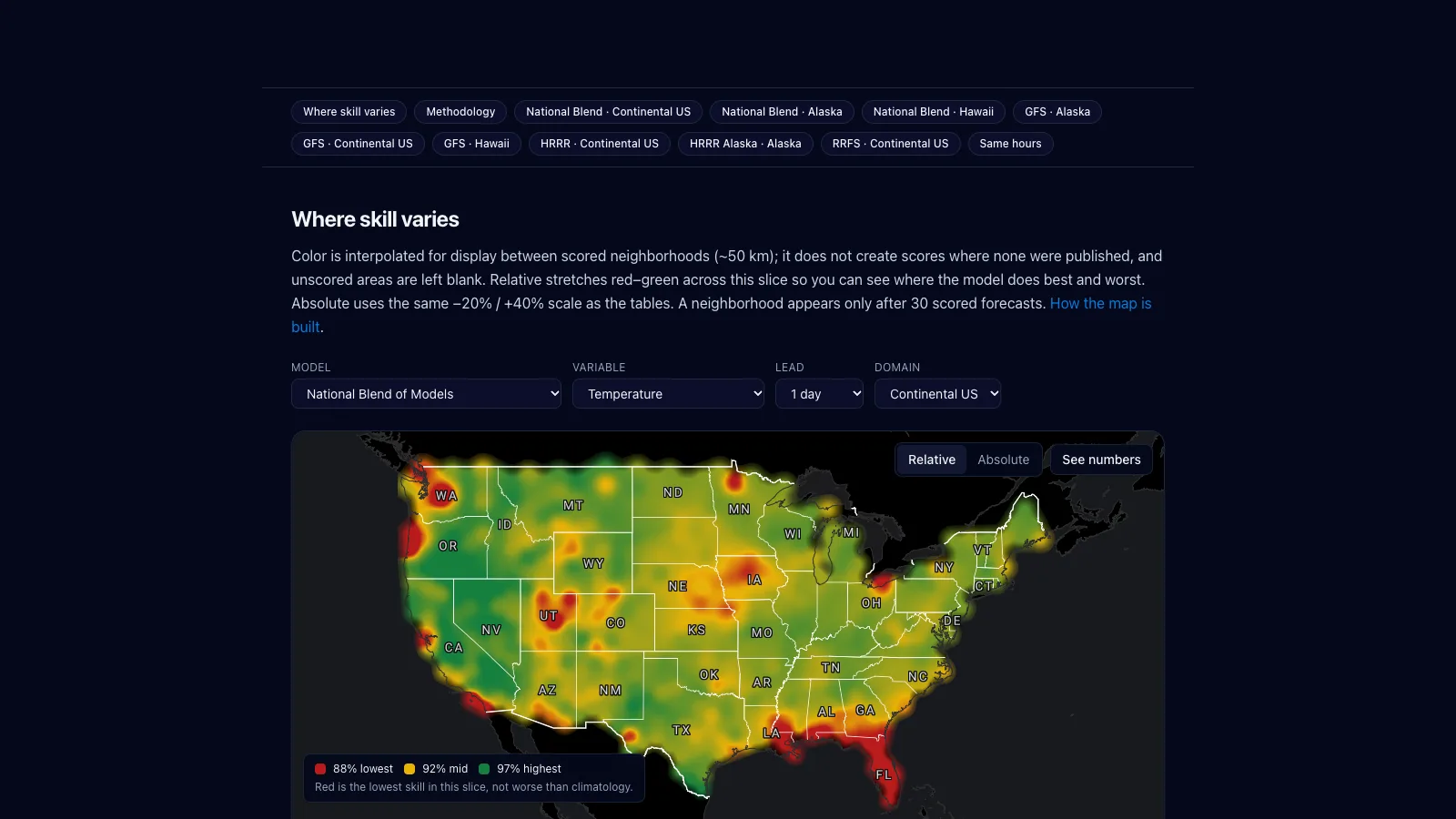
For temperature, wind, and other continuous fields the headline is a mean-squared-error skill score: one minus the model's squared error over the variance of the analysis values we actually scored. The reference is this sample's local average, not a 30-year climate normal. Chance of rain uses a Brier skill score against how often it rained in the sample. Rain-or-not uses an equitable threat score, which does not get easier just because a climate is wet. Negative skill is published. A cell with fewer than 30 pairs is left blank, not smoothed.
Why the record has to be kept as it happens
The analysis we pair against expires in about two days. A valid hour we miss in that window is gone — we cannot reconstruct last month. That is why a public skill number is rare, and why starting the same measurement today still starts at zero.
How to read it
We accumulate by neighborhood, about 50 km across, because a national average mixes the Gulf Coast with the Front Range. We do not put two models side by side and declare a winner: those rows are not a matched sample. When NBM is stale and we served HRRR, that hour is not in the NBM card. Formulas, the 30-pair floor, and what we withhold are on the methodology page.